Showing posts with label Gargiulo. Show all posts

Sunday, June 26, 2011

An Analysis of a Storied Approach to Crafting Influential Messages

Terrence Gargiulo's 2011 Commencement Address

A Little Background Story for Context…

Forty years ago I found myself at the first of many interesting educational crossroads. New to Monterey, California my family searched for a school for my sister to attend. After a brief stint in one of the public schools my parents enrolled Franca at Santa Catalina School. It was an all-girls school from Pre-Kindergarten (PreK) through high school run by Domincan nuns.

Somehow the school decided it would entertain a wild and crazy idea: start boys in the PreK. Maybe they needed revenue, maybe they were curious, I honestly don’t know what precipitated the change. I found myself invited to be one of the few, one of the proud, and one of the lucky boys invited to partake in this great experiment.

Turned out they really liked us boys. Each year they kept deciding to let us stay another year. By the time we got to fourth grade they decided we could stay for good. However, we were to be the first class to graduate from eighth grade. This year, the school asked me to commemorate that decision and honor me by giving the lower school address commencement address.


The Challenge…

While I am asked frequently to do keynote addresses, I’m not a huge fan of them. It’s just hard to touch people. Perform, impress, command attention, wield pulpit power and create passive hope for people are opportunities offered by keynoting. I hunger for the intimacy of inciting insights that comes from facilitated storytelling. As a general rule, I set the value of keynoting high, ensuring that only the most serious clients engage me in this way. I also almost always insist on being given other opportunities to work with some of the member of the audience in a different setting other than the plenary address.

The commencement address for Santa Catalina School was for middle school students, parents, teachers and administrators. How could I hold the attention of a diverse audience? Could I create a fertile space of imagination to offer some tangible gifts to aid them on the next part of their journey? How would I make it be about them? Could I avoid clichés, hype, and platitudes? Would I be able to minimize perfunctory pomp and circumstances perpetuated by this genre of speech? How would I be fun and serious at the same time? Would I have to keep my message super simple with only one or two key take-a-ways or could I tackle a complex set of concepts? And could the whole address be done completely with story forms employing my authentic voice?

The Approach…

Despite my familiarity with the school (my son and daughter attend the school) I wanted to hold the graduating students in my heart. Whether or not my clients realize it or not I probe client engagement requirements and stakeholder perspectives with the natural power of story. I elicit stories. Call me wedded to my storied ways, but I don’t know any other way to quickly infer patterns in complex systems. This might seem counter-intuitive but when faced with the speed of business in today’s environment stories are the fastest and most efficient vehicle for analysis and communication.

“Storytelling is a safe space for creative thinking, negotiating differences, and establishing commonality. Storytelling empowers the speaker and improves communication through speaking and listening. Stories are the most efficient way of storing, retrieving, and conveying information. Since story hearing requires active participation on the part of the listener, stories are the most profoundly social form of communication.” – http://www.makingstories.net
I had a few data points about the graduating class and other stakeholders. I filled these in with a couple of informal conversations with teachers, observations of the students leading up to graduation day and an hour meeting with the principal.

Where care is present stories flourish. The shortest distance between two people is a story. Since my children are still in kindergarten and third grade, I did not know the principal of the middle school well. Stories beget stories. An hour flew by in no time but surfaced a wealth of stories. More importantly without me overtly asking the question, “what gift (ideas) do you want to offer these students to help them succeed?” a clear concentration of three major themes emerged. These were judgment, compassion, and mercy. Armed with the gifts and a feel for the students both as individuals and as a class I was equipped to craft my message.

The Story Architecture of the Message…


Two days after my meeting with the principal while sitting on the soccer field watching my son’s practice I conceived the following architecture for the talk in my notebook:

It’s up to you but I recommend watching the video before reading the analysis. This sketch from my notebook and the story architecture will probably make more sense if you watched the video:

Santa Catalina Commencement Address from Terrence Gargiulo on Vimeo.

Let me try to decipher my notes from above for you:

1. After the formal alphabet soup introduction of credentials quickly use humor to create credibility of a personal nature somehow related to the students and audience. Get them immediately involved in the talk. Do this with humor and a quick anecdote. In this case I had a fun and fluid self-effacing bridge to construct between us.

2. Quickly make the talk all about them. Create a rapid interactive collage of small moments and anecdotes that highlights things about the students.

3. Layout a roadmap for the rest of talk. Five stories will be used. Three stories comprised the students’ gifts for their journey (judgment, compassion and mercy). On either end of the three gift stories were two stories. One to illustrate the results of failing to invoke these gifts and the last story for showcasing the impact of when all the gifts are working together.

4. Short interlude of scenarios of when and how these gifts might be necessary. I start with an example of to the daily application of these gifts in my life as a father. Then I offered situations the students are likely to experience in the next leg of their journey.

5. Return to humor I used in the opening of the talk. While being funny, lace it with a serious message in a song that connects with the gifts shared.

6. End with two brief quotes that support and segue into a closing image and metaphor.

Lessons Learned…

I was very purposeful in deciding what kind of stories to use in the talk. Variety and diversity are important. I feel stories need to from many different domains and genres to cast the story net as wide as possible. It can be easy to become too narrow or focused in what kind of stories we tell or how tightly encoded are driving messages are embedded in the stories.

Let me say a little more about this idea of working too hard to couple our message with our stories. I look for a pattern of themes. If I can tag a story with a word closely related to one of the major themes I am trying to communicate that is good enough. I do not need a story that is a perfect illustration of my message; quite the contrary. I want stories that are just a little fuzzy. Allow people to use their sense giving telescope to bring the story into focus. Let your listeners go in the direction most needed by them in the moment. Leave it rich enough that there is lots of room for them to wander through the patterning of stories to uncover new threads of meaning.

By their nature stories are fluid. Stories overlap memories with the context of the moment. I find stories in collages and clusters to be more truthful than pinning the entirety of a message in a single story. All the greatest stories are vast little universes with an orbit of small story fragments. The depth and veracity of stories is more easily perceived when scanning the pattern and intention of stories in proximity with one another. I am naturally distrustful of single isolated large perfect stories with clean beginning, middles, and ends and unmistakable story arcs. In many instances these stories have already been warped around the gravity of a pre-digested message. Stories are creative acts and furthermore I view them as co-creative stages on which themes, drama, and meanings emerge in a process of co-creation. The story is only one small part of the key. The decoding and collaborative sense making space generated by telling a story to trigger the stories of others is sacred. My experience has been that when this space opens up, storytelling and listening is authentic, deep, and responsive to the needs of the moment. The space falls apart when listening ceases and any one person returns to advancing a monocular agenda.
Strategic Use of Stories in Organizational Communication & Learning, Gargiulo 2006

There’s something else wonderful that happens when you work with collage of stories. The stories begin to entwine themselves to each other. For example, I did not architect the triple place of music in the talk – it just sort of happened. There is the musical reference at the beginning of the talk, two of the student anecdotes involve music, the story of Emmanual Jal the hip hop artists and then my closing song. On the one hand there is nothing extraordinary about this phenomenon since it’s just what naturally occurs with stories. It also helps that I come from a musical family so I am naturally drawn to musical stories; yet every time I see stories work their magic I am grateful and humbled by the experience.

Here is how I selected the type of stories to use at the various points of my talk:

• Personal History (in my opening humor) – first a small piece of shared experience that I had with them and then move to a quick scene of my longtime affiliation with the school

• Student Anecdotes – things I observed and learned about the students – to establish them as the heroes of the talk, to demonstrate care and listening

• Personal Anecdote – of a time I failed to access the virtues of judgment, compassion, and mercy and a simple expression of regret

• Two Movie Stories – popular archetypal movies (Lord of the Rings and Star Wars) to share the gift of judgment

• Story from a Book – Gregory Boyle’s book, Tattoos on the Heart, for the gift of compassion

• Historical Story of Major Personality – a story about Pope John Paul II for the gift of mercy

• Life Story of Contemporary Young Personality – share the story of the young hip-hop artist Emmanuel Jal to show what it looks like when the gifts of judgment, compassion, and mercy are all working together

• Scenario Stories – these are rhetorical questions that paint a scene of daily opportunities for judgment, compassion, and mercy to manifest themselves, start with the personal then move back to students

• Story as Music – sing a short song to introduce humor and tie back to themes introduced throughout the talk

• Story as Metaphor and Imagery – setup an image that encompasses the three gifts that relates back to the students as heroes, start with two quotes end with vivid word picture

A Few Tips You Might Find Useful…

I have a confession to make…I never practiced this talk and I went to the podium with no notes. All I had was a pair of shorts that I wore when I was in pre-kindergarten at Santa Catalina. Sure, I had told two of these stories in another venue but almost all of the material was new to me. What I did do is spend a lot of time reflecting and visualizing the story architecture of the talk. I also spent a considerable time holding the students in my heart.

Here are a few tips you might find helpful:

• Try not to get bogged down in style. I know what my strengths are. I am genuine, warm, intense, energetic, and personal. Each person has a distinct and beautiful footprint that animates their style. One thing that does transcend style is selflessness.

• Care about what you have to say and care about the people. The rest is very individual.

• Work to make stories in all their forms a central part of how you understand your message, craft your message and deliver your message.

• Think in terms of collages of stories. Avoid single stories. There’s a place for them and I am not recommending you abandon great stories with visible arcs, surprises, and tensions. Lots of stories orbiting your talk pull people into the gravity of your message.

• Delivery matters but not as much as you think. If you get caught up in the ground swell of stories you are sharing and your audience, you’ll be surprised at how an effective tone, color, and character emerges.

• Don’t work so hard to script these things. Anchor yourself on a few key phrases at pivotal moments of the talk and imagine yourself delivering these.

WOULD YOU LIKE A COPY OF THIS POST AS A WHITE PAPER?
CLICK HERE


Thursday, April 28, 2011

Organizational Judgment


Judgments separate us from others. They hold us secure and tight in assumed positions of superiority.

What if we let the scaffolding of being judgmental drop away?

Can we really halt our knee jerk reflexes to label, categorize and evaluate people’s actions and words based our individually constructed value driven world view?

While good intentions and self-awareness are a start - they're not enough...

Stories help me quite.

Take a moment and please watch this short video...


I've posted this video on my Voice Thread site - this a free service that allows people to post comments in a vareity of ways including audio (recorded either from your machines mic or even by dialing a phone number to record your comments), video comments, text, and the ability to upload images, documents, presentations, etc...

I'd love for you to share your thoughts, ideas and reactions with me and each other. Here's the link:


These are skills that can be developed. Organizational cultures can weave these into the fabric of their cultures and reap the performance benefits. Interested in learning more about these skills?


Check out my model of story-based communication skills:
Interested in learning more - consider giving me (Terrence Gargiulo) a call - 415-948-8087.

Sunday, October 17, 2010

Nancy Duarte's New Book Resonate


Think about what happens when you strike a pitch fork and then bring another one close to it. The second dormant fork picks up the vibrations of the other. The two forks begin sharing the same frequency.

This is exactly what happens with stories. Neuroscientists can show us now with real data how a listener and speaker become harmonized in a shared space of story. As I share a story with an intention of care and a genuine drive to connect with myself and others, my brainwaves and the brainwaves of my listeners will become coordinated. Sense making replaces chaos. A temporary structure of meaning becomes a suspended moment where the flurry of sight, sounds, and sensations becomes the quiet eye of the storm around us.

Learning and insight can occur here. Time slows down. It's a state of mindfulness and engagement. We hunger to step into the geometry of this archeticture. We are more deeply ourselves...more deeply connected...more deeply human.

Nancy Duarte's book is brilliant. She has taken the lessons of one story form - the hero's journey and mapped "sparklines." These sparklines are guided by the archetypal structure of the hero's journey and shows how presentations and communications can be molded around this scaffolding to create powerful communications.

I am proud to have worked with Nancy on her latest book. Be sure to check out page 106 to find out what Nancy's grandmother, cookies, and stories all can teach us about how we all have an opportunity to change the world.

Congratulations Nancy! You've brought a level of insight and innovation to the field of communications!

Speech Write extraordinaire Ian Griffin interviewed me at Nancy's book party last week. Here's a link from his blog to what five of us leaders in the field had to say...

LEARN MORE

Wanna Buy the Book?


Friday, May 7, 2010

Organizational Discombobulation

Are things falling apart all around you? Have you been hit with discombobulation? This fast paced video turns our prevalent notions of sense making on its head. It’s always bothered me that when we talk about story we usually talk about stories requiring Beginnings, Middles, and Ends. I don’t disagree. I’ve finally been able to put my finger on what I felt compelled to articulate…

Watch and see what discombobulation, stories, and a new way of thinking about stories adds to your current way of thinking about them. Then be sure to add your voice to the conversation, after all stories beg us to co-create with each other.


Monday, March 29, 2010

Organizational Needs....


Maslow’s hierarchy of needs has taught us a lot about the basic things we require. There are the necessities like bread…water but what about less tangible needs and how do these needs express themselves in our organizations?

My wife is a child and family therapist working with families affected by adoption. Like bread and water children subsist on the connections they form; without these their development becomes threatened. In her field they term this waltz of intimacy attachment. We know it when we see it…imagine a child on a beach with an approaching rough wave – and a mother’s securing hand is ready for the taking without a child searching or asking for it. This attachment…this bond becomes a sort of unconscious part of our DNA driving the fruition and articulation of relationships.

Maybe it boils down this…are we available and responsive to one another?

Watch this 2 minute video as a conversation starter...


Organizational Needs from Terrence Gargiulo on Vimeo.

So do you know what resources your organization needs to survive and thrive? And what really sustains people in organizations?

Are you interested in learning more about these story-based communication skills? Here are some additional resources:

1. Journal Article - "Strategic Use of Stories"

2. eBook of Self-development Exercises (for individuals & groups)

3. Award winning Assessment Instrument for measuring story-based communication skills

4. Sample Chapter from Once Upon a Time: Using Story-based Activities to Develop Breakthrough Communication Skills - book of group process/experiential learning activities mapped to the nine story-based communication skills

Now please sure to leave your thoughts, ideas and reactions to enrich this virtual campfire for others!

Monday, November 30, 2009

Managing Cross Generation Meetings...


FROM MAKINGSTORIES.net ARCHIVES

I continue to go through the MAKINGSTORIES.net archives and find one gem after another. I don't stop long enough to real give any of these things I create enough time to get out there. I'm too busy being creating the next thing - a gift and a blessing indeed!

Last year I did a webinar with Robert Wendover from the Center for Generational Studies. We wrote back in 2005 a super cool book for AMACOM titled,
On Cloud Nine:Weathering Many Generations in the Workplace. I wrote a very amusing and all humility aside - sparkling little gems of fable.

In the webinar Bob and I give you a taste for the fable and dive into a discussion of how to manage inter-generational meetings. Here's the marketing blurb about the webinar...

Learn five powerful solutions for boosting meeting productivity in 40 minutes flat!

We’ve all been there – the weekly staff meeting – the Boomers are sharing what they did over the weekend – the Xers are anxious to get it over ASAP – the Millennials are texting their friends, updating Twitter, and shopping on-line. There’s got to be a better way – and there is!

Join Terrence Gargiulo and Robert Wendover, co-authors of On Cloud Nine: Weathering the Challenge of Many Generations in the Workplace, as they reveal the secrets for navigating the meeting needs and expectations of those ages 17 to 70. With the increasing pressures on time and money, you can’t afford this time-wise webinar. We all know the problems, this is about the solutions. Come away with the tricks you need to manage meeting times in a productive and efficient way.
Here's an archived video of the presentation...

Managing Cross Generational Meetings from Terrence Gargiulo on Vimeo.


SUMMARY OF FOUR STRATEGIES DISCUSSED

Managing Cross-Generational Meetings
Robert W. Wendover
The Center for Generational Studies


It happens all the time. We sit in a meeting. The topic needs to be addressed but isn’t all that interesting. The person presenting or facilitating the discussion struggles to keep everyone engaged. We look around the room. A few people are offering ideas and discussing the issue. Others are doing non-related paperwork. Still others are surfing the Web on their handhelds or even texting each other under the table about how boring the meeting is.

With the pressure to do more with less these days, few people have the tolerance to sit through a meeting that they perceive as wasting their time. This is especially true of emerging professionals who are so conscious of their time to begin with. So how can we find a way to manage meetings effectively, particularly across the generations? Here are some ideas:

Commit “Meetingus vanishus.” Many people have concluded that as a society, we meet too much. Ask people about all the different meetings to which they are committed to each week and you’ll get a list of five or more. Ask those same people how many are really necessary and they will roll their eyes. Dare to ask those attending regular meetings if the meeting is really necessary. Press for the truth and you’ll probably get a good feel for which meetings can be eliminated.

But information does have to be disseminated. The obvious answer is technology. Decide what can be distributed electronically and then develop a means for do so. Several years ago, banking giant Capital One purchased 3000 iPods, for instance, and distributed them to managers and other professionals across the organization. “Feel free to use the iPod to your hearts content,” these people were told. All we ask is that when the company sends you podcasts on topics ranging from training issues to financial updates that you listen to the information.” This practice has consequently saved thousands hours of time and added millions of dollars to the bottom line.

Cross generate the meeting. The person in charge tends to be the person running the meeting. Who says that’s the best way to get things done? Try appointing individuals from different generations to the role of meeting leader. This can accomplish several goals: 1) It will re-engage those who have disengaged from the meeting’s purpose. 2) It will foster the creativity of those in the room. 3) It will demonstrate the different approaches to getting the meeting objective accomplished. 4) It will help those in charge to identify the leadership attributes within the team.

Establish upright meetings. Who says meetings have to take place in a reclining position? More than one manager has discovered that simply gathering people together on the factory floor or office break room is an effective way to get a quick decision. Why not take more advantage of this strategy? If some privacy is needed, remove the chairs from the room ahead of time. Sure there may be a few comments, but the result with be a quicker and more effective meeting. Don’t believe me? Just try it a couple of times.

Meet virtually. Even if everyone attending is in the same facility, it can be more efficient to meet via a telephone bridge or conferencing software. Since most people comfortable multi-taking their way through the day, this practice will enable them to improve their efficiency and still participate in a meaningful way.

Robert W. Wendover is director of The Center for Generational Studies and author The Sandwich Manager: Simple Solutions for Supervising Those Seventeen to Seventy. Contact him at wendover@gentrends.com.


Check out
more information on the book


So how are you managing these dynamics? Tell us your story.


Wednesday, August 12, 2009

Leadership & Storytelling Part 10 of Many...


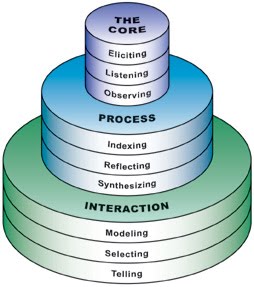
We start our detailed look at story-based communication model for leaders by looking at the Interaction Ring.

The Interaction Ring with its three skills describes how we use stories to connect with others and communicate. The three skills are:

1. Selecting
2. Telling
3. Modeling

This is the tip of the iceberg. When people think of storytelling skills these are the ones that come rushing to mind.


The Interaction Ring contains the competencies that are most noticeable by outside observers. Selecting, Telling and Modeling describe how we use stories to communicate. In actuality, these are the least important competencies. They demonstrate mastery of the competencies found in the Core and Process Ring without which the competencies in the Interaction Ring amount too little more than showmanship. The Interaction Ring is the icing on the cake. All the other competencies have to be working in concert in order for us to be effective communicators and learners regardless of how clever we are in selecting stories, how theatrically we tell them, what behaviors we model or analogies we leverage to explain ourselves.


SELECTING COMPETENCY

One of the questions I get asked the most is, “how do you know what story to tell?” It’s an excellent question. Of course the setting of where a story is to be told has a lot to do with it. Stepping back to do an audience analysis will be instrumental in guiding you. For example, it is more straightforward when you are giving a presentation at a conference in front of a large audience than if you are attempting to select a story on the fly in an informal conversation. When you have advance information about who the people are, why they are coming, and a sense of what you think they want to get out of your talk than it is easy to use your preparation time to scan a wide assortment of story options. However, when we do not have the luxury of planning, selecting a story becomes more challenging. In these extemporaneous settings you must rely on the “listening” competencies of the Core, and the Indexing competency from the Process Ring. How to select a story is a function of our index.

Here's a complimentary copy of a tool I developed to help leaders select stories.

Complimentary Tool for Selecting Stories: Click Here...


We'll be continuing our exploration of the Interaction Ring and the two other skills in the next two blog entries.


All of these skills can be measured with the only assessment in the world that measured story-based communication skills (recognized in 2008 with an HR Leadership Award from the Asia Pacific HRM Congress).

Story-based Communication Assessment: Click Here...


I also have a book of self-development exercises to work on these skills with yourself or others. All of these exercises that map to the nine skills of the competency model


Book of Self-Development Exercises: Click Here...


I also recommend my book, Once Upon a Time: Using Story-Based Activities to Develop Breakthrough Communication Skills. It contains a collection of group process activities aligned with these story-based communication skills.

Tuesday, August 4, 2009

Leadership & Storytelling Part 6 of Many...

6. Park the Ego

Conviction and self-confidence are key attributes of a leader, and as such they help her develop a healthy ego. However, when ego consumes a leader’s perceptiveness and becomes a tool of power versus inspiration, it has ceased to serve the leader well and has become dangerous to all. Leaders must learn how to draw internal strength from their egos while simultaneously parking them out of the way. Leaders who put others first do so by attending to the egos of others and not to theirs.


Practice

• Reflect on things about yourself (skills, abilities, qualities, experience, knowledge, . . .and so forth) that you are very confident about. Then reflect on areas where you are less sure of yourself. Our egos tend to be more dominant in areas where we lack true self-confidence and self-esteem. Identify these areas in yourself and others, and be watchful. These are the areas where our egos can easily get out of control.

• Give other people the opportunity to take the lead in areas where you have more experience. Act as a coach rather than as a doer all the time.


Be sure to check out my upcoming webinar with Shawn Callahan of Anecdote on August 19th, 2009...

Three Questions We Usually Get from Leaders About Storytelling: Reflections, Discussion & Tools.

Click Here to Learn More...

Friday, June 5, 2009

Nine Functions of Stories...

One of the ways I have been able to wrap mind around stories is to think about some of the different ways they function and the unique effects these functions have. Here's a summary chart:

Stories are used to:

Stories have the following effects:

1. Empower a speaker

2. Create an environment

3. Bind and bond individuals

Entertain

Create trust and openness between yourself and others

Elicit stories from others

4. Engage our minds in active listening

5. Negotiate differences

Listen actively in order to:

Understand context and perspective

Identify the root cause of a problem

Uncover resistance and hidden agendas

Shift perspectives in order to:

See each other

Experience empathy

Enter new frames of reference

Hold diverse points of view

Become aware of operating biases and values

6. Encode information

7. Act as tools for thinking

8. Serve as weapons

9. Bring about healing

Create a working metaphor to illuminate an opinion, rationale, vision, or decision.

Establish connections between different ideas and concepts to support an opinion or decision

Think outside the box to generate creative solutions and breakthroughs.


When you tell a story to a group think in terms of how it will help you set the stage and model the ground rules you wish to follow for a learning event. As a general rule of thumb, if we are a little vulnerable, circumspect, and reflective, and if we don’t take ourselves too seriously, our intentions will spread through the group and positively affect its behaviors. People will also form better bonds with one another. Each story told exposes more points of connections between people.


Steer away from using stories to just to encode information. Stories that encode predigested messages such as allegories or fables offer the weakest form of communication and learning. For example,

The Fox and the Lion

When a fox that had never yet seen a Lion, fell in with him by chance for the first time in the forest, he was so frightened that he nearly died with fear. On meeting him for the second time, he was still much alarmed, but not to the same extent as at first. On seeing him the third time, he so increased in boldness that he went up to him and commenced a familiar conversation with him. Acquaintance softens prejudices.

The story above illustrates a point but lacks richness since it is being used as a vehicle to deliver a simple message. Encoding information is only one function of stories and any story will always have information encoded in it. When we limit stories in a premeditated way to carrying one or two simple messages, we throw away the opportunity for complexity to emerge. Although it is probably one of the most familiar functions of stories, it is often the least useful one for creating compelling experiential dialogues that can catapult learners to new insights. Experiential learning requires us to help people suspend their habitual ways of thinking to make room for new perspectives.


The most important function of stories is that they require active listening. By their nature stories trick us into hearing ourselves and each other in deeper and fuller ways. When people listen actively to one another they enter the world of another person. Our understanding of another person’s story is gained by working with bits and pieces of our own stories to find common connections between the story being shared and our own experiences. While we are dependent upon our experiences to construct meaning out of what another person shares with us, we are less likely to narrowly fixate on evaluating their story in terms of our world view. Like dreams that can present contradictory elements yet still be real (e.g. swimming and flying at the same time, or a person that appears in the dream is two people at the same time) stories invite us to work with conflicting things. When we actively listen to someone’s story we are not as emotionally invested in our point of view. Differences become opportunities. Empathy can be a wonderful byproduct of stories. Since experiential learning bridges the gap between people’s current knowledge and desired learning, stories facilitate leaps of imagination that might never be realized by other modes of instruction.


Stories are wonderful tools for thinking. You can place people vicariously into a story and use it to work through new ideas and solutions. For example, if we you were leading a discussion on leadership you might ask the group to explore how the story and characters of the Wizard of Oz offer insights into the nature of leadership. As long as people know the story they will jump right into it and use it as template for abstract thinking. The energy this creates in a group is contagious. The story mode of discussion will touch every kind of thinking and communication style in the room. Creative types will love coming up with zany connections between the Wizard of Oz and leadership while more analytical types of people will enjoy exploring the details and nuances of the connections being found.


Stories as weapons or tools for healing are the last two functions of stories. When someone uses a story to coerce a point of view or manipulate people’s perceptions to serve their agenda it becomes dangerous. Influence is a natural and ever present facet of communicating but when the power of stories is used to maliciously mislead people it constitutes an abuse.


Whether we use stories as a weapon consciously or not it’s a violation of people’s imagination and disrespects the space of active listening created by stories. Here’s an example. I was attending a costal planning meeting. During the course of heated debate on where boundaries of a no-fishing zone should be drawn someone held up a picture of a handicapped person fishing off a pier that was located in an area of the no-fishing zone being proposed. A picture is worth a thousand words and a story is worth a thousand pictures. Put the two together and you have a powerful punch. The commissioners at the meeting were taken by the picture and its story about providing access to handicapped people to fishing. It affected their vote. The pier depicted in the picture was not included in commission’s no-fishing zone. Later it was discovered that the picture had been posed; the person in the picture was not even handicapped. The picture and its story had been used as a weapon.


Conversely, stories can be used for healing. There is a rich tradition of the role of narrative in many therapeutic practices. Facilitating group processes even in an organizational setting can unearth some intense emotions and perceptions. Revisiting a story and examining how the story relates to other experiences adds unpredictable layers of meaning and dimensionality. During the process of sharing a story, dialoging with others about it and reflecting, the story is released from the past and given meaning in the present. In this way stories provide the raw material for encouraging new insights that can lead to creative solutions and the possibility of healing.


When stories commingle with each other pathways emerge. Stories can unlock novel ways of seeing ourselves and making sense of the world. I was facilitating a leadership workshop where after sharing many experiences a senior level executive became aware of how he had a habit of showing disrespect towards his colleagues. Without any sermonizing or prescription on my part or the group, this executive saw a pattern in his stories. These stories projected a reality he was not satisfied with and one which he wished to alter. Through the stories he gained an invaluable lens that helped him to see himself more honestly and which gave him the courage to free himself from repeating self-defeating stories.


As you become more aware of how the nine functions of stories operate you will get better at naturally leveraging their unique effects to facilitate breakthrough communication and learning. I no longer think about it. Sharing stories and eliciting people’s stories is what I do every time I am leading a conversation with a group. I have developed sensitivity to how these functions of stories and their unique effects impact group processes. I strive to seize the opportunities they create while remaining attentive to the ethical implications of putting people in learning situations they may not want to be. Stories can be raw and not everyone wants to either look at themselves or be exposed in front of others. There are no hard and fast rules about this stuff, as you develop a feel for healthy boundaries learn to watch people in the group carefully to discern subtle cues as to how much they are willing to share and how deeply they want to reflect on it with the group.


Monday, May 25, 2009

Poetic Vision of Stories & A Story Benediction


Stories fold in and out of themselves to reveal subtle worlds of meanings, purpose, and connections.

They are gentle transporters bound by time but that travel beyond the boundaries of what we have experienced at any given point in time.

Stories free us to move through a landscape of change. We leave the dusty road of the familiar and embrace a void where we can find the freedom to chose and perceive new realities and project worlds of our own making.

Stories can either crush illusions we have become enslaved to due to habit or they can lift our veils of fear and familiarity and give us a glimpse of new ways of being. Here we will find a place where we can be our unique selves while in communion with others.

Terrence L. Gargiulo


May stories...
Stir you heart,
Inform your thoughts
and guide your actions

Saturday, May 23, 2009

Initial Thoughts on Stories

Here are some thoughts that give shape to some of the ways I have come to think about stories...

Stories are fundamental to how we communicate, learn and think.

The shortest distance between two people is a story.

Stories are less about telling and more about listening and eliciting.

The only reason to tell is a story is to trigger more stories and insights from within ourselves or draw out (elicit) the stories of thers.

We have all the story equipment to connect with yourself and others in rich ways. How often are we using it? Do we use it in conscious and purposeful ways? Do we create environments that encourage others to share their stories?

Stories go beyond the obvious ways that we use them to encode information.

Play with the counter-intuitive notions that stories are implicit in nature; encoding messages clear cut messages to move learning, emotions, ideas or values is only the tip of the iceberg and perhaps the least important capacity of stories.

To be called a story - a story does not need to have a clear beginning, middle and end or recognizable story trajectory. By accepting this we are neither negating story in its obvious forms or diluting the notion of stories.

Stories create spaces of trust and relationships. They are living entities made real and present by the reflecting, remembering, and imagining of people engaged with each other.

Stories achieve their greatest power in concert with each other.

Stories are emergent in nature.

Through stories we enact versus announce our intentions.

Our actions impregnate the moment with new stories creating possibilities and ripples of sense making and future sense giving of others.